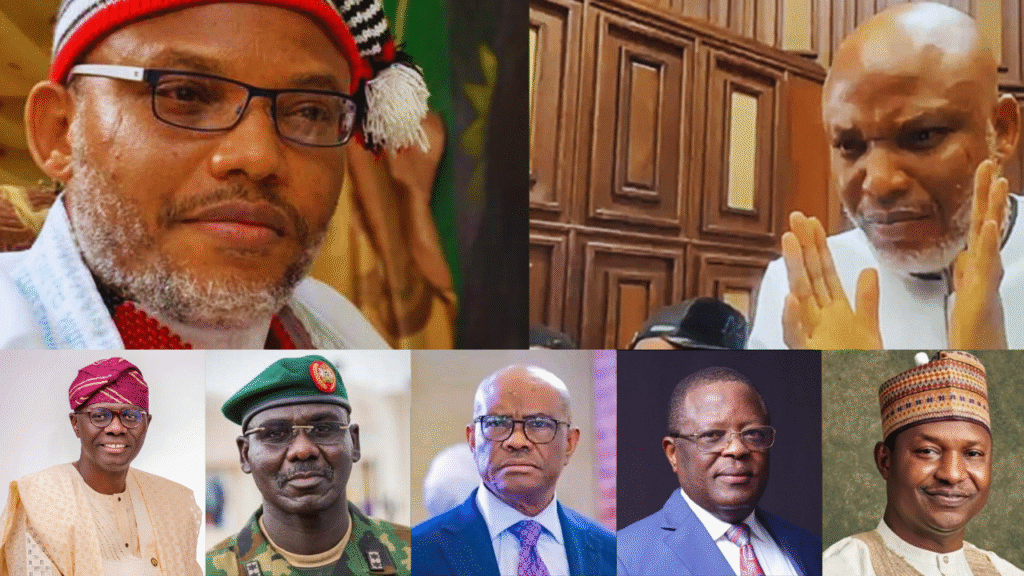
In a significant development in his ongoing terrorism trial, the leader of the Indigenous People of Biafra (IPOB), Nnamdi Kanu, has filed a motion naming 23 defence witnesses, including several high-profile Nigerian political and military figures.
Among those listed are former Attorney General and Minister of Justice, Abubakar Malami (SAN); Minister of the Federal Capital Territory (FCT), Nyesom Wike; Minister of Works, Dave Umahi; Lagos State Governor, Babajide Sanwo-Olu; and former Chief of Army Staff, Lt. Gen. Tukur Buratai (rtd). The inclusion of these prominent names has stirred public and legal interest, adding a new layer of intrigue to one of Nigeria’s most closely watched trials.
According to court filings, Kanu categorized his witnesses into two groups — “ordinary but material witnesses” and “vital and compellable witnesses” — citing Section 232 of the Evidence Act as the legal basis for summoning them. His defence team also requested 90 days to present its case in full, pointing to the complexity and volume of testimonies expected from the witnesses.
Legal experts have described Kanu’s move as both strategically bold and procedurally complex, as it could compel top government officials and military leaders to appear in court for cross-examination. However, analysts warn that significant legal and logistical challenges may arise, including questions around jurisdiction, compellability of witnesses, and national security implications.
Some observers believe the strategy could be aimed not only at strengthening his legal defence but also at shaping public perception by highlighting the roles of influential figures in his case. Others argue that the approach might spark a fresh round of political and institutional tensions, depending on how the court handles the request.
As proceedings continue, attention is now focused on how the court will rule on the motion and whether these high-profile witnesses will indeed be summoned. The outcome could set a precedent for how political, military, and judicial interactions unfold in high-stakes trials across Nigeria.