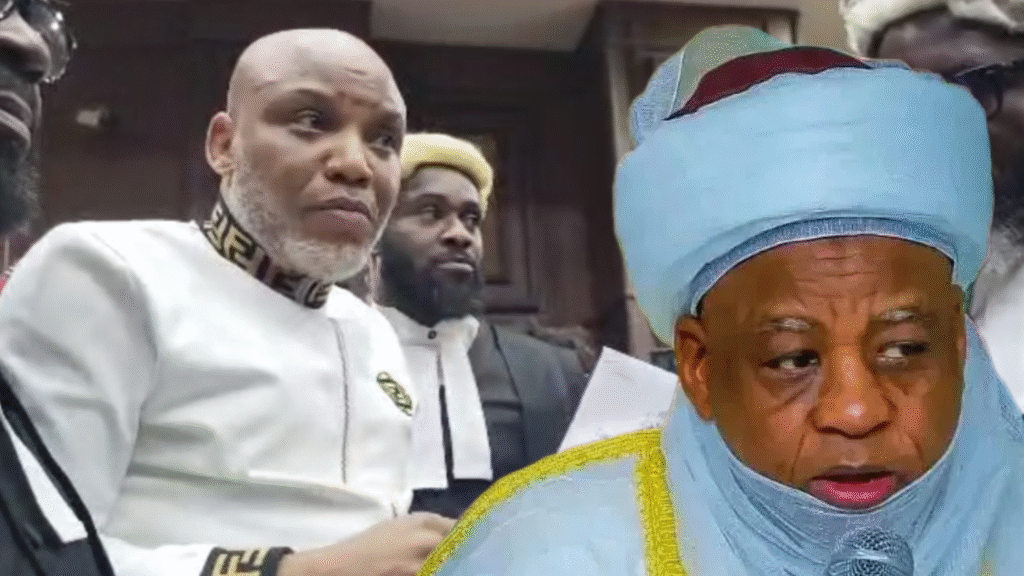
A widely circulated and deeply provocative rumour has dominated social media and political discourse: the alleged plan by the revered Sultan of Sokoto to confer a traditional turbaning honour upon the detained leader of the Indigenous People of Biafra (IPOB), Mazi Nnamdi Kanu. While the veracity of the claim remains highly contested and has been met with both disbelief and intense political analysis, the mere trending of such a story underscores the volatile, yet yearning, political atmosphere surrounding Kanu’s protracted legal and political standoff. This alleged gesture, if confirmed, would represent a seismic shift in national dialogue—a high-stakes move toward political and ethnic reconciliation led by one of Nigeria’s most respected traditional and religious figures.
The Sultan of Sokoto, as the President-General of the Nigerian Supreme Council for Islamic Affairs (NSCIA) and the spiritual leader of Nigerian Muslims, holds immense moral and traditional authority across the country. Turbaning, in Northern tradition, is a profound honour, signifying recognition, leadership, and a call to service within the community or, in this context, a significant political statement. The idea of the Sultan extending such an olive branch to Kanu—a figure whose agitation has been centrally focused on the secession of the South-East and who has been detained on terrorism charges—is a development of unparalleled political magnitude. It suggests a desire among key national power brokers to move beyond the punitive legal approach to address the root causes of the South-East agitation through dialogue and cultural respect.
Analysing the political landscape, this purported move can be interpreted through several lenses. Firstly, it indicates a growing recognition among Nigeria’s traditional and moral establishment that the issues driving groups like IPOB are complex and cannot be solved solely through military or legal means. It signals a shift towards addressing the emotional and historical grievances that fuel separatist movements. Secondly, such a high-profile, non-governmental gesture could be seen as an effort to facilitate the current legal and political efforts to secure Kanu’s release, offering a pathway for the Federal Government to de-escalate tensions without appearing to capitulate to pressure. It would provide a political justification for a potential negotiated settlement, framing the outcome as an act of national unity and inclusion.
The potential implications for national unity are staggering. A traditional honour conferred by the highest authority in the North upon the most significant figure in the South-East’s struggle for self-determination would instantly become the most powerful symbolic act of reconciliation in decades. It would force a reconsideration of regional and religious stereotypes and could pave the way for other ethnic and political leaders to engage in genuine national dialogue. However, the move is fraught with risk. It could be viewed by some hardline elements in both the North and South-East as an unacceptable compromise or a political betrayal, potentially causing internal friction within the Sultanate and within IPOB’s own ranks.
Until an official clarification is made by the Sultanate, the story remains a powerful reflection of the nation’s political temperature. The fact that it gained so much traction online highlights the public’s deep-seated yearning for a resolution to the Kanu saga and the broader South-East insecurity. Whether factual or purely speculative, the trending rumour of a Sultan-Kanu rapprochement underscores the vital role traditional rulers can play as moral arbitrators in Nigeria’s complex political mosaic, serving as a powerful thought experiment on the path to national healing. The conversation it has generated is, in itself, a form of necessary, if volatile, national dialogue.