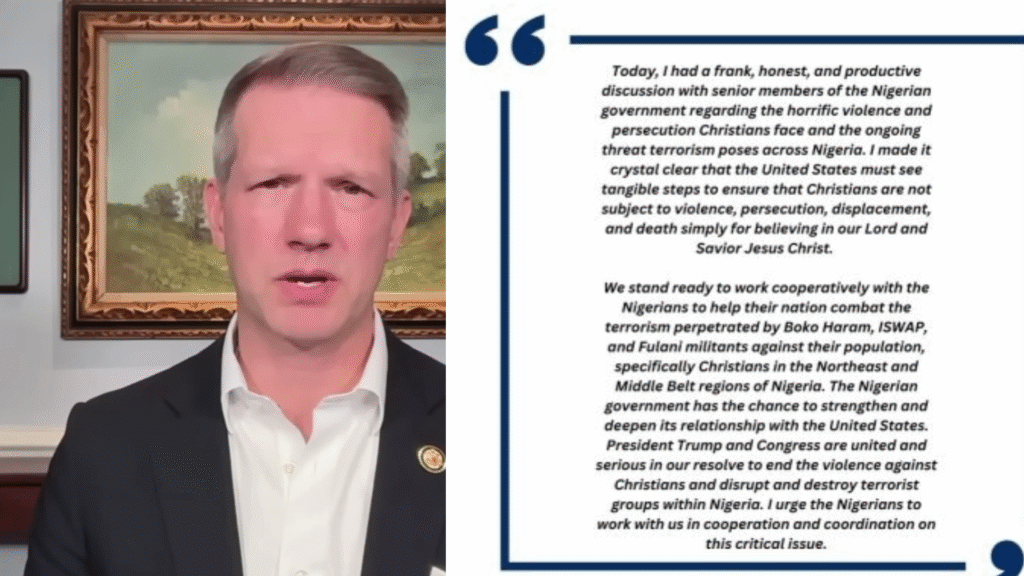
A high-level meeting between a United States Congressman and a Nigerian delegation has intensified ongoing global debates surrounding the alleged persecution of Christians in Nigeria. The closed-door session, held in Washington, came amid renewed pressure from U.S. lawmakers, international NGOs, and diaspora organisations calling for a deeper investigation into the rising attacks on Christian communities, particularly in northern and Middle Belt Nigeria.
According to sources familiar with the meeting, the Congressman, known for being one of the most vocal advocates on religious freedom issues, expressed serious concern about Nigeria’s deteriorating security situation. He reportedly highlighted multiple incidents of mass killings, church burnings, targeted attacks on clergy, and continuous displacement of Christian farmers in conflict-prone regions.
The Nigerian delegation, consisting of lawmakers, civil society representatives, and diplomatic officials, defended Nigeria’s position, insisting that the violence in the country is not strictly religious but driven by complex factors ranging from terrorism to land disputes, climate migration, and political manipulation. They argued that portraying the Nigerian crisis as one-sided persecution risks oversimplifying a deeper, multifaceted security problem.
However, the U.S. Congressman pressed further, citing years of documented attacks allegedly targeting Christian populations. He pointed to international reports indicating that Christian-majority villages have been disproportionately affected by killings and displacement linked to extremist groups and armed militias.
Members of the Nigerian delegation urged the U.S. to exercise caution and avoid conclusions that could inflame religious tensions domestically. They also requested increased U.S. support in intelligence, counter-terrorism logistics, and community-level stabilisation programmes that could help address insecurity holistically.
Observers say the meeting underscores a growing divide between Nigeria’s official narrative and rising international scepticism. Human rights organisations have long argued that Nigeria is not doing enough to protect vulnerable Christian communities, especially in remote towns that suffer attack after attack with minimal government response.
Diplomatic analysts warn that these meetings, while constructive, point to a dangerous trajectory: if the U.S. concludes that Nigeria is failing to act, it may impose visa bans, military restrictions, or targeted sanctions on key officials. Such a move could strain diplomatic relations, affect military cooperation, and hurt Nigeria’s global image.
Christian associations at home have welcomed the international attention, saying domestic cries for justice have gone unanswered for years. Meanwhile, some northern leaders have condemned the U.S. for “selective outrage,” insisting that Muslim communities are equally victims of violence.
As global attention mounts, the Nigerian government is now under pressure to present verifiable action plans, not just statements, on how it intends to address rising insecurity.
The meeting is expected to be followed by further congressional reviews, with more hearings planned in the coming weeks.